
Sensor observation times, aligned poses, and optional frame-arrival evidence. More...
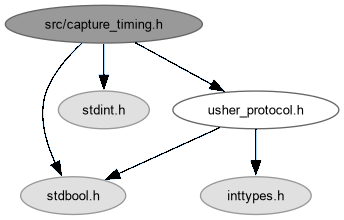

Go to the source code of this file.
Data Structures | |
| struct | capture_observation |
| struct | capture_timing |
| Shared observation evidence with optional LWIR request/frame-delivery timing. More... | |
Functions | |
| static bool | capture_observation_valid (const struct capture_observation *observation) |
| Check that an observation supplies a usable time interval. | |
| static bool | capture_observation_exposure (const struct capture_observation *observation) |
| Distinguish exposure evidence from other valid observation times. | |
| static bool | capture_observation_latency (struct capture_observation *observation, uint64_t arrival_us, uint64_t minimum_us, uint64_t maximum_us) |
| Bound exposure time using calibrated frame delivery latency. | |
| static const char * | capture_time_name (enum capture_time_kind kind) |
| Get the text label used when recording observation timing. | |
| static bool | capture_timing_valid (const struct capture_timing *timing) |
| Check whether timing evidence is internally consistent and recent. | |
Detailed Description
Sensor observation times, aligned poses, and optional frame-arrival evidence.
Timing is deliberately represented with monotonic clocks only; wall-clock adjustments must never turn an otherwise valid capture into a negative duration.
Definition in file capture_timing.h.
Enumeration Type Documentation
◆ capture_time_kind
| enum capture_time_kind |
| Enumerator | |
|---|---|
| CAPTURE_TIME_UNKNOWN | |
| CAPTURE_TIME_SENSOR_EXPOSURE | |
| CAPTURE_TIME_CALIBRATED_EXPOSURE | |
| CAPTURE_TIME_SHUTTER_WINDOW | |
| CAPTURE_TIME_FRAME_ARRIVAL | |
| CAPTURE_TIME_AUDIO_WINDOW | |
Definition at line 32 of file capture_timing.h.
Function Documentation
◆ capture_observation_exposure()
|
inlinestatic |
Distinguish exposure evidence from other valid observation times.
- Parameters
-
observation Nullable observation to classify.
- Returns
- True for a valid sensor, calibrated, or shutter-window interval.
Downstream projection must not substitute frame delivery or audio timing for exposure, even if those intervals are structurally valid.
Definition at line 78 of file capture_timing.h.
◆ capture_observation_latency()
|
inlinestatic |
Bound exposure time using calibrated frame delivery latency.
- Parameters
-
[in,out] observation Record to update; existing pose validity is cleared. arrival_us Frame arrival in local monotonic microseconds. minimum_us Shortest calibrated exposure-to-arrival delay, in microseconds. maximum_us Longest calibrated exposure-to-arrival delay, in microseconds.
- Returns
- True if the interval was written; false leaves the record unchanged.
The longest delay gives the earliest plausible exposure. Reject bounds that would underflow or reach time zero, and require a fresh pose alignment after changing the interval.
Definition at line 96 of file capture_timing.h.
◆ capture_observation_valid()
|
inlinestatic |
Check that an observation supplies a usable time interval.
- Parameters
-
observation Nullable observation to check.
- Returns
- True for a known timing kind with an ordered, nonzero-start interval spanning no more than 20 seconds.
Check endpoint order before subtracting unsigned timestamps. This validates the interval only, not its pose, sequence, or frame association.
Definition at line 63 of file capture_timing.h.
◆ capture_time_name()
|
inlinestatic |
Get the text label used when recording observation timing.
- Parameters
-
kind Source of the timing evidence.
- Returns
- Borrowed static string, or
unavailablefor an unrecognized kind.
Labels retain the distinction between an exposure estimate and frame delivery so that downstream log readers do not conflate the two.
Definition at line 115 of file capture_timing.h.
◆ capture_timing_valid()
|
inlinestatic |
Check whether timing evidence is internally consistent and recent.
- Parameters
-
timing Evidence to inspect.
- Returns
- True for a plausible request/arrival pair, false otherwise.
The 20-second bound detects stale parser state without rejecting normal warmup/USB recovery behavior. Callback and polling modes have intentionally distinct sequence invariants, reflected in the final conditional.
Definition at line 155 of file capture_timing.h.