
Loading...
Searching...
No Matches
dipla_gp_belief_planner.cpp File Reference
Finite-grid GP observations, uncertainty updates, and reference route scoring. More...
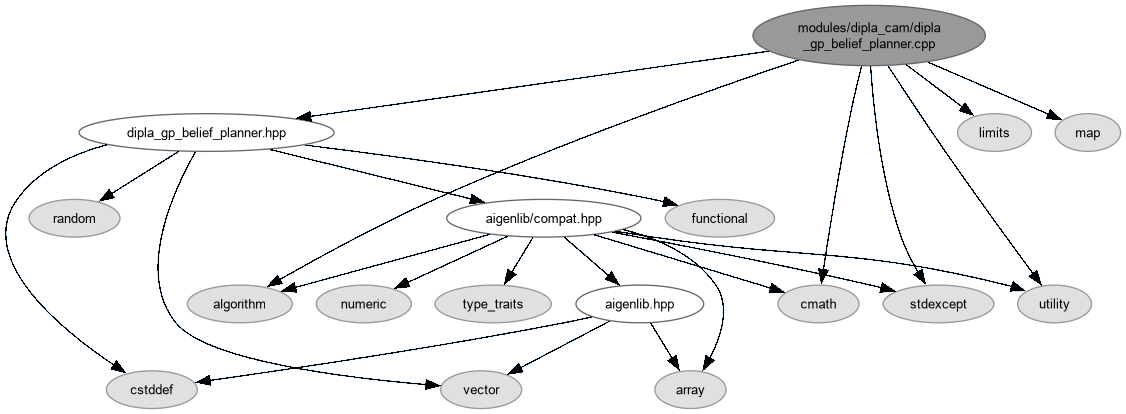
#include "dipla_gp_belief_planner.hpp"#include <algorithm>#include <cmath>#include <limits>#include <map>#include <stdexcept>#include <utility>
Include dependency graph for dipla_gp_belief_planner.cpp:
Go to the source code of this file.
Namespaces | |
| namespace | aipp |
Functions | |
| double | aipp::fov_radius (double altitude, double angle=60.0) |
| Compute the ground-plane footprint radius from altitude and full FOV angle. | |
| int | aipp::resolution_block_size (double altitude) |
| Select the research sensor's altitude-dependent aggregation block size. | |
| double | aipp::noise_model (double altitude, double minimum_altitude=10.0) |
| Compute modeled observation variance at an altitude. | |
| Matrix | aipp::initialize_covariance (const Grid &grid, double sigma2, double lengthscale) |
| Initialize a dense Matérn-3/2 GP covariance matrix. | |
| Sensor | aipp::build_sensor (const Grid &grid, const Point &pose, double angle=60.0, double observation_variance=-1.0) |
| Build one block-averaged sensor footprint at a pose. | |
| Sensor | aipp::future_sensor (const Grid &grid, const std::vector< Point > &path, double angle=60.0, int stride=lookahead_stride, int max_measurements=lookahead_measurement_budget, double observation_variance=-1.0) |
| Approximate future measurements along a path under a bounded budget. | |
| Vector | aipp::observe (const Sensor &sensor, const Vector &field) |
| Apply the sensor's block averages to a full-grid field. | |
| Vector | aipp::sample_sensor_noise (const Sensor &sensor, std::mt19937_64 &generator) |
| Draw independent zero-mean noise using each sensor row's variance. | |
| std::vector< bool > | aipp::importance_mask (const Vector &mean, const Matrix &covariance, const PlannerOptions &options) |
| Select cells whose confidence bounds satisfy the utility threshold. | |
| double | aipp::expected_reduction (const Matrix &covariance, const std::vector< bool > &mask, const Sensor &sensor) |
| Sum expected marginal-variance reduction over important cells. | |
| void | aipp::condition (Matrix &covariance, Vector *mean, const Sensor &sensor, const Vector *measurement) |
| Apply a Gaussian linear-observation update in place. | |
| Point | aipp::clip_point (const Grid &grid, const Point &point, const PlannerOptions &options) |
| Clamp a candidate to the map safety inset and altitude interval. | |
| std::vector< Point > | aipp::lattice (const Grid &grid, const PlannerOptions &options) |
| Generate the deduplicated coarse-to-fine candidate lattice. | |
| std::vector< Point > | aipp::spline (const Point &start, const std::vector< Point > &waypoints, int samples_per_segment=spline_samples_per_segment) |
| Interpolate controls with a natural cubic spline parameterized by distance. | |
| double | aipp::trajectory_objective (const Grid &grid, const Matrix &covariance, const std::vector< bool > &mask, const Point &start, const std::vector< Point > &raw_waypoints, const PlannerOptions &options) |
| Score a trajectory by safety violation and distance-normalized information gain. | |
| std::vector< Point > | aipp::grid_search (const Grid &grid, const Vector &mean, const Matrix &covariance, const Point &start, const PlannerOptions &options) |
| Greedily select a bounded route by information gain per travel cost. | |
Detailed Description
Finite-grid GP observations, uncertainty updates, and reference route scoring.
Despite the historical filename, this file does not train the ONNX denoiser. It maintains and queries a Gaussian-process (GP) belief about a scalar field, builds synthetic sensor operators, and provides the greedy/spline machinery used by the explicitly selected comparison planner.
- The shared linear-observation model
- For N grid cells and M sensor rows, each row of H uniformly averages its listed cells. We store those indices rather than a mostly zero M-by-N matrix. Sigma is the dense N-by-N covariance; R is diagonal independent sensor noise. Expected information gain needs the covariance update but not future measured values. That distinction lets look-ahead reduce hypothetical uncertainty without handing the planner the hidden field's answer sheet.P = H * Sigma (M by N)S = H * Sigma * H^T + R (M by M)B = solve(S, P) (M by N)posterior_mean = mean + B^T * (measurement - H * mean)posterior_covariance = Sigma - P^T * B
- When changing numerical behavior
- The Eigen branch below and the default aigenlib kernels implement the same valid-input model. Keep operator weights, grid order, solver cutoffs, and reduction rules aligned, and run differential tests when changing either. Public contracts stay in the header; implementation notes here explain why.
- Warning
- Grid construction caps N, not whole-process memory. One 2601-by-2601 double covariance is about 51.6 MiB; hypothetical copies, M-by-N workspaces, and solver allocations are additional. Some helpers assume valid inputs rather than checking every precondition in both numerical backends.
- See also
- dipla_gp_belief_planner.hpp Public geometry, sensor, and planner API.
Definition in file dipla_gp_belief_planner.cpp.