
Pose-free thermal components using caller-owned bounded scratch storage. More...
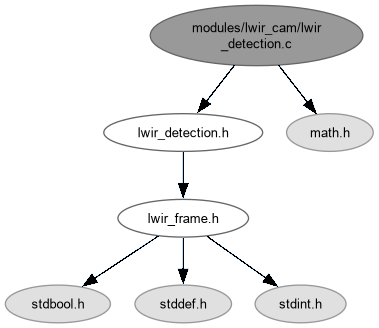
Go to the source code of this file.
Enumerations | |
| enum | { lwir_hotspot_radius = 5 } |
Functions | |
| static uint16_t | read_u16_le (const uint8_t *bytes) |
| Decode one unsigned 16-bit little-endian value. | |
| static bool | valid_code (uint16_t raw) |
| Whether a raw code is a real measurement rather than a sensor endpoint code. | |
| static bool | bit_is_set (const struct lwir_detection_workspace *workspace, size_t pixel) |
| Test a pixel's visited bit. | |
| static void | mark_bit (struct lwir_detection_workspace *workspace, size_t pixel) |
| Set a pixel's visited bit. | |
| static void | histogram_clear (struct lwir_detection_workspace *workspace) |
| Zero all 65536 histogram bins. | |
| static double | histogram_median (const struct lwir_detection_workspace *workspace, uint64_t count) |
| Exact median of the values counted in the histogram. | |
| static bool | candidate_better (const struct lwir_hotspot *candidate, const struct lwir_hotspot *current, bool tray_order) |
| Ranking predicate for retained candidates. | |
| static void | retain_candidate (struct lwir_hotspot candidates[2], size_t *count, const struct lwir_hotspot *candidate, bool tray_order) |
| Insert a candidate into a sorted top-two list. | |
| bool | lwir_detect_hotspots (const uint8_t *temperature, size_t bytes, unsigned width, unsigned height, struct lwir_detection_workspace *workspace, struct lwir_hotspot_set *result) |
| Detect and rank hot connected components in a native temperature plane. | |
Detailed Description
Pose-free thermal components using caller-owned bounded scratch storage.
Analysis builds only (LWIR_ENABLE_ANALYSIS=1). Operates on the exact native Kelvin*64 plane recovered from a saved LWIR JPEG. Algorithm outline:
- Robust frame statistics: exact median (background) and median absolute deviation (noise) via 65536-bin histograms, so no sorting buffer is needed.
- Global threshold combining an absolute floor with a robust rise over background.
- 8-connected flood fill (breadth-first) of above-threshold pixels.
- Per component: local background, contrast gate, excess-weighted subpixel centroid and shape features.
- Keep the top two generic and top two tray-like components; report trays if any.
Cost trade-off: every component clears and scans the full 65536-bin histogram for its local median, so frames with many small components cost roughly 65536 operations per component in addition to the per-pixel work.
Definition in file lwir_detection.c.
Enumeration Type Documentation
◆ anonymous enum
| anonymous enum |
| Enumerator | |
|---|---|
| lwir_hotspot_radius | |
Definition at line 39 of file lwir_detection.c.
Function Documentation
◆ bit_is_set()
|
static |
Test a pixel's visited bit.
- Parameters
-
workspace Scratch storage holding the bitset. pixel Row-major native index within the current frame.
- Returns
- True when the pixel was already queued.
Definition at line 70 of file lwir_detection.c.
◆ candidate_better()
|
static |
Ranking predicate for retained candidates.
Generic order: higher contrast first, then larger excess heat. Tray order: larger excess heat first (presumably favouring an extended hot tray over a small very hot point), then contrast. A full tie returns false, so the earlier-found component (row-major seed order) keeps its place.
- Parameters
-
candidate Newly evaluated component. current Retained component it is compared against. tray_order Select the tray ordering instead of the generic one.
- Returns
- True when
candidateshould rank strictly abovecurrent.
Definition at line 130 of file lwir_detection.c.
◆ histogram_clear()
|
static |
Zero all 65536 histogram bins.
- Parameters
-
workspace Scratch storage holding the histogram.
Definition at line 90 of file lwir_detection.c.
◆ histogram_median()
|
static |
Exact median of the values counted in the histogram.
Walks the cumulative count once to find the lower and upper middle ranks; for an even count the result is their mean, so it can end in .5. Exact for integer inputs, avoiding a sort and a pixel-sized copy.
- Parameters
-
workspace Scratch storage whose histogram holds exactly countsamples.count Number of samples; must be at least 1 ((count - 1) would wrap).
- Returns
- Median value in histogram-bin units.
Definition at line 104 of file lwir_detection.c.
◆ lwir_detect_hotspots()
| bool lwir_detect_hotspots | ( | const uint8_t * | temperature, |
| size_t | bytes, | ||
| unsigned | width, | ||
| unsigned | height, | ||
| struct lwir_detection_workspace * | workspace, | ||
| struct lwir_hotspot_set * | result ) |
Detect and rank hot connected components in a native temperature plane.
Rank native thermal components without touching hardware, pose or files.
See lwir_detection.h for the contract and the file overview for the algorithm. All arithmetic stays in raw Kelvin*64 codes until results are converted to Celsius (code / 64 - 273.15); temperature differences convert by dividing by 64 only.
- Returns
- True for a valid plane (even with zero candidates); false for invalid arguments.
Definition at line 172 of file lwir_detection.c.
◆ mark_bit()
|
static |
Set a pixel's visited bit.
A bitset (rather than a byte per pixel) keeps the workspace small.
- Parameters
-
workspace Scratch storage holding the bitset. pixel Row-major native index within the current frame.
Definition at line 81 of file lwir_detection.c.
◆ read_u16_le()
|
static |
Decode one unsigned 16-bit little-endian value.
- Parameters
-
bytes At least two readable bytes; no alignment requirement.
- Returns
- The decoded value, independent of host endianness.
Definition at line 46 of file lwir_detection.c.
◆ retain_candidate()
|
static |
Insert a candidate into a sorted top-two list.
Insertion sort over a fixed two-slot array: while fewer than two are held the list grows; afterwards a candidate must beat the current second place to enter, and the displaced second place is dropped.
- Parameters
-
candidates Sorted list, best first. [in,out] count Valid entries (0..2); incremented while below 2. candidate Component to consider; copied by value. tray_order Ordering passed to candidate_better().
Definition at line 150 of file lwir_detection.c.
◆ valid_code()
|
static |
Whether a raw code is a real measurement rather than a sensor endpoint code.
0 and 65535 (about 751 C, beyond the Tiny1C range) mark invalid or missing samples, never real temperatures, so they must not shape statistics or become hotspots.
- Parameters
-
raw Kelvin*64 code.
- Returns
- True for codes 1..65534.
Definition at line 59 of file lwir_detection.c.